
Golf in Art History
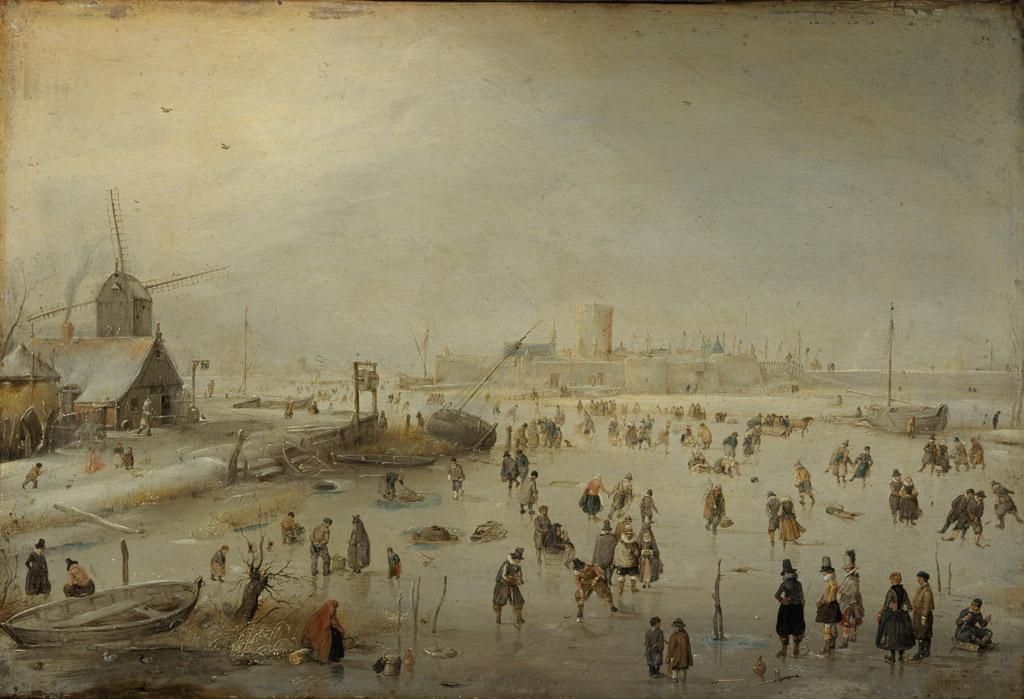
Winter Landscape, ca. 1630
Hendrick Avercamp’s winter scene conveys a message about democratic social values: various classes – rich and poor, old and young, male and female – are bound together through leisure. Nevertheless, kolf was connected to elite status in seventeenth-century Dutch society, here evidenced by the players’ colorful, elegant clothing. The copper support, unusual for Avercamp, provides a smooth surface appropriate to the gemlike quality of the depiction. Two thin tree trunks enclosed in the ice provide the goal for the group of four kolfers in the right foreground.Hendrick Avercamp (Dutch, 1585-1634), Winter Landscape, ca. 1630, oil on copper, 11 1/4 x 16 3/4 inches. Scottish National Gallery.
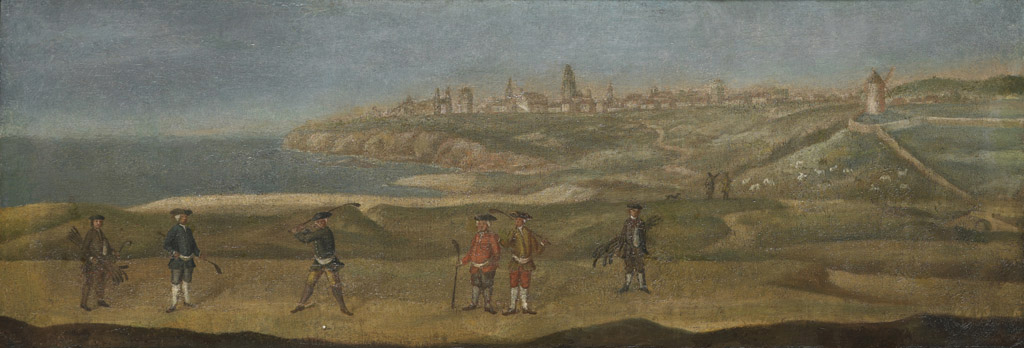
View of St Andrews from the Old Course, ca. 1740
This view of St Andrews is the earliest known representation of golf being played in Scotland. Two rustic shepherds watch golfers and caddies, while a nearby flock of sheep is seemingly unbothered by the game afoot. Images of The Royal and Ancient Golf Club of St Andrews did not become common until the 1840s, by which time the windmill at right was no longer standing.Unknown artist, View of St Andrews from the Old Course, ca. 1740, oil on canvas, 14 x 39 9/16 inches. Reproduced by kind permission of The Royal and Ancient Golf Club of St Andrews. Digital image: The Bridgeman Art Library International.
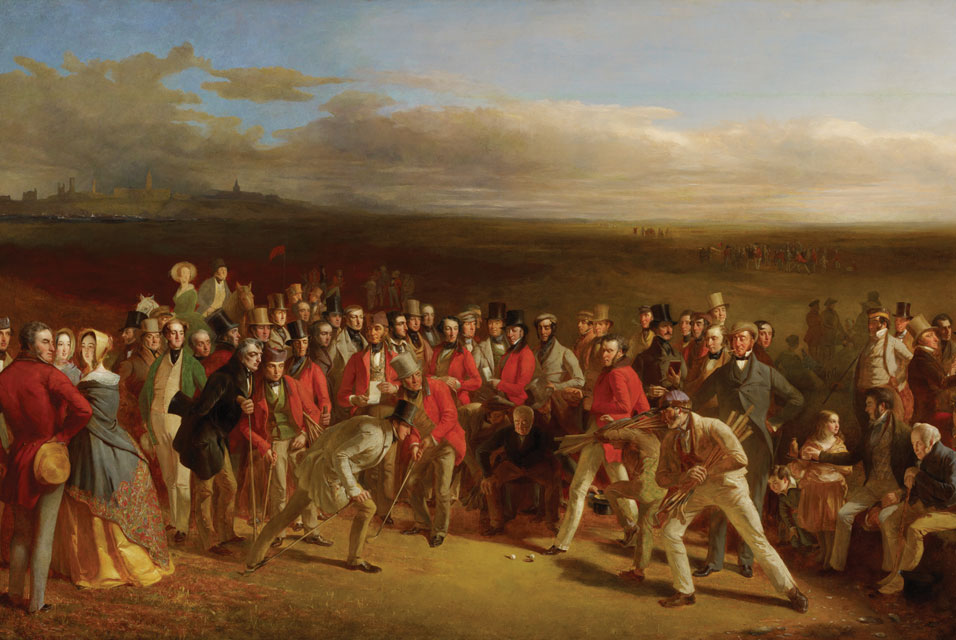
The Golfers, 1847
This large painting shows a match being played on the Old Course at the Royal and Ancient Golf Club, St Andrews. The center of everybody’s attention is a decisive moment in a match between Sir David Baird and Sir Ralph Anstruther against Major Hugh Lyon Playfair and John Campbell of Glen Saddel. Lees carefully composed this complex scene, which includes over fifty individual portraits, using photographs of some of the golfers to help him.Jointly owned by the National Galleries of Scotland and the Royal and Ancient Golf Club, this masterpiece has never before traveled to the United States, though reproductions of it hang in golf clubhouses around the world. Displayed alongside the painting while at the High will be several preparatory sketches, all portraits of individuals who can be identified in the painting, and an early photograph by Hill and Adamson to which Lees referred as he composed his painting.Charles Lees was born in Cupar, Fife. He trained as a painter in Edinburgh with the eminent portraitist, Sir Henry Raeburn. After six months in Rome he returned to Edinburgh where he established himself as a portrait painter. Lees was elected a Royal Scottish Academician in 1830. From the 1840s Lees built himself a reputation as a specialist in depicting sporting subjects; The Golfers was his first major sporting picture.Charles Lees (Scottish, 1800–1880), The Golfers, 1847. Oil on canvas, 51½ x 84¼ inches.
Scottish National Portrait Gallery, purchased with the assistance of the Heritage Lottery Fund,
The Art Fund and the Royal and
Ancient Golf Club, 2002, PG 3299.
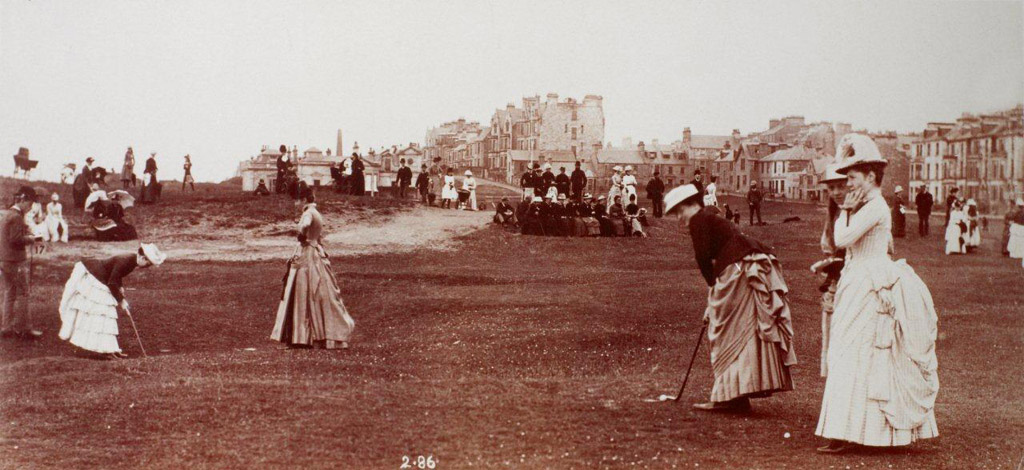
The Ladies’ Club, 1886
Formed in 1867, the St Andrews Ladies Club grew to include 500 members within twenty years—a total close to that of the exclusively male Royal and Ancient Golf Club of St Andrew’s membership of 795. Strict conventions governing acceptable dress meant that women were obliged to play in the restrictive, tightly laced, full-length clothes then deemed fashionable and appropriate. More practical golfing attire became popular at the turn of the century.Unknown Photographer, The Ladies’ Club, 1886, photograph, 14 1/8 x 22 3/8 inches. British Golf Museum. Reproduced by kind permission of The Royal and Ancient Golf Club of St Andrews.
John Shippen, undated
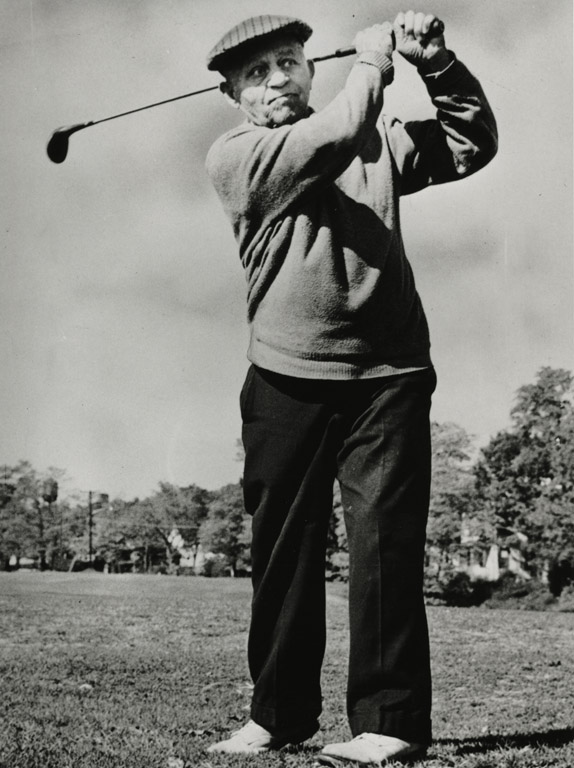
In 1896 John Shippen (1879–1968) became the first African American golfer to compete in the U.S. Open. He was sixteen years old when he entered the event at Shinnecock Hills Golf Club. Protests were raised from both British and Scottish professionals in the field, but USGA president Theodore Havemeyer allowed Shippen to compete and he finished fifth. Shippen played in five more U.S. Open championships and was the head professional at the Shady Rest Golf and Country Club in Scotch Plains, New Jersey, from 1924 to 1960. In 2009 the PGA of America granted him a posthumous membership.Unknown Photographer, John Shippen,undated, Gelatin Silver Print,United States Golf Association Museum and Archives, Far Hills, New Jersey
Tom Morris, Sr., 1903
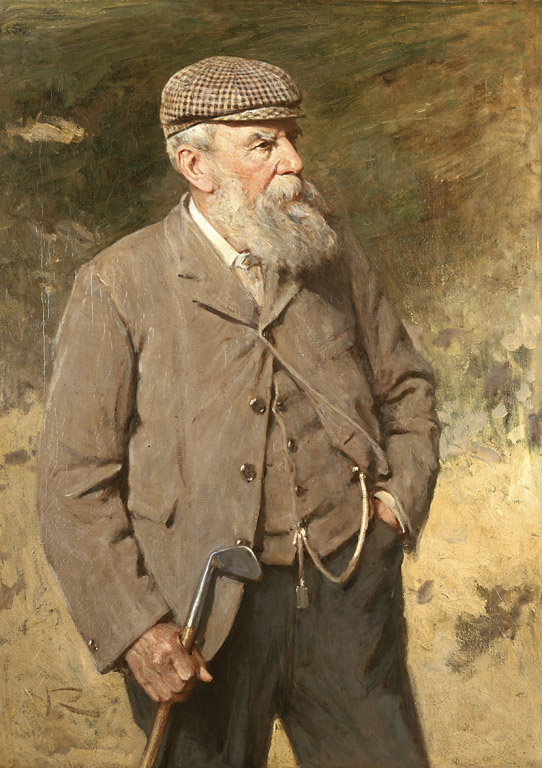
In 1902 The Royal and Ancient Golf Club of St Andrews commissioned George Reid to paint a portrait of Tom Morris, then aged eighty-one, to commemorate his many years of service and profound dedication to the Club. In addition to winning the Open Championship four times between 1861 and 1867, Morris founded a thriving club- and ball-manufacturing business, designed many golf courses, and revolutionized greenkeeping techniques. This painting usually hangs in the Big Room of The Royal and Ancient Golf Club’s of St Andrew’s clubhouse.Sir George Reid (Scottish, 1841-1913), Tom Morris, Sr., 1903, oil on canvas, 60 3/8 x 44 3/8 inches. Reproduced by kind permission of The Royal and Ancient Golf Club of St Andrews.
Old Man Tracy of Tracy and Tracy, 1926
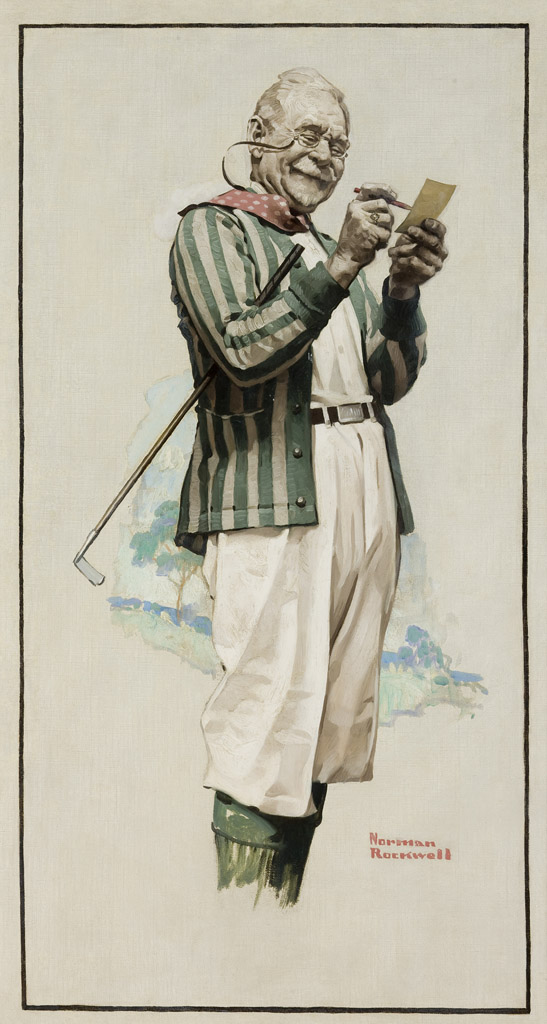
Humor is integral to the game of golf—anyone who has played it knows that elements of the absurd and ridiculous are, indeed, “par for the course”—and humorists often use it as a subject, parodying the game that Mark Twain once called “a good walk spoiled.” The subject of golf was a perfect match for Norman Rockwell, whose style is distinguished by great attention to detail and a love of the anecdotal vignette. This wonderful piece combines his signature sense of humor with the American love for the game of golf.Norman Rockwell (American, 1894-1978), Old Man Tracy of Tracy and Tracy, 1926, oil on canvas, 22 x 36 inches. United States Golf Association Museum, Far Hills, New Jersey. Photo by Cindy Momchilov.
Bobby Jones, 1926
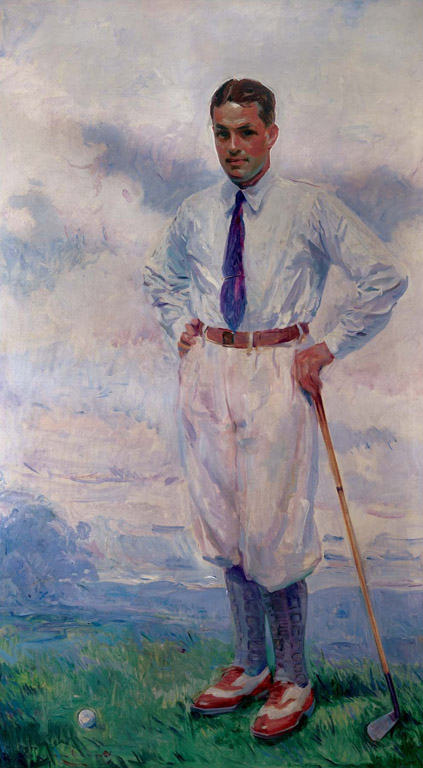
In 1926 a group of prominent Atlanta businessmen commissioned Wayman Adams to commemorate Jones after he won “The Double”—the U.S. Open and the British Open. The portrait was paid for by subscriptions to the Atlanta Georgian and the Sunday American and presented to Jones. One of the businessmen, J. J. Haverty, founder of Haverty’s Furniture and early supporter of the High, encouraged the artist in a letter, writing, “you are not making the portrait of sport, but of a young man with a high order of mental capacity, of wonderful concentration, self-control, culture, determination, and ambition.”Wayman Adams (American, 1883-1959) Bobby Jones, 1926, oil on canvas, 80 x 47 inches. Courtesy of Atlanta Athletic Club.
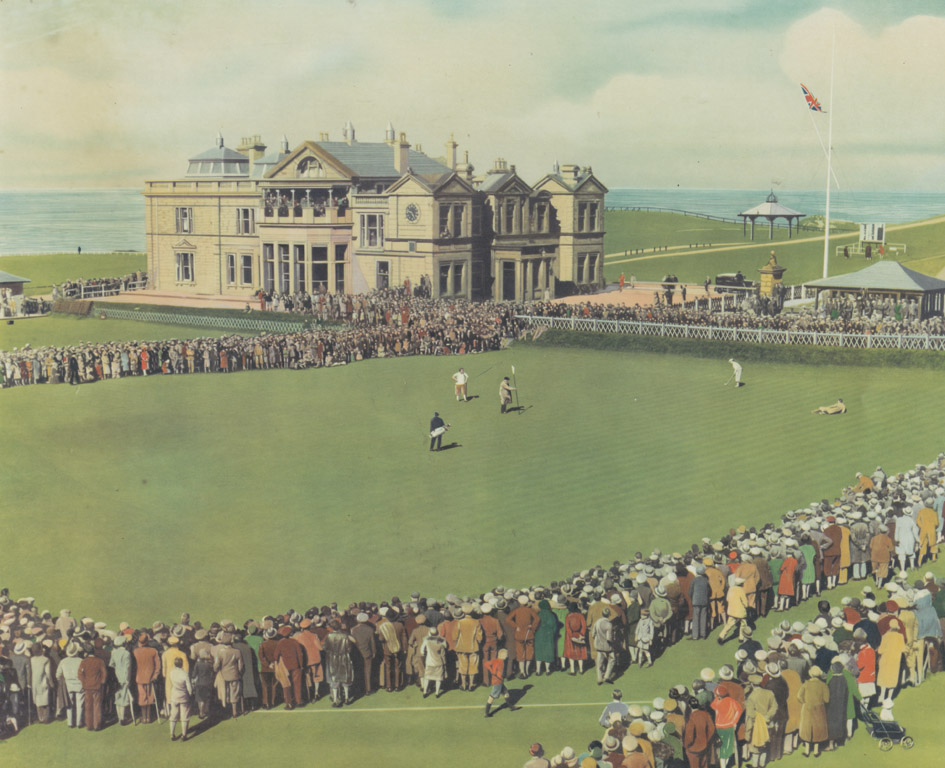
Robert T. Jones Winning the British Amateur at St Andrews, 1930
Printed in the United Kingdom after Bobby Jones won the Grand Slam, this original color lithograph depicts his historic shot on the eighteenth green. The British Amateur was the first leg of what became known as the Grand Slam, and Jones had never before won this event. Upon his victory, he was swarmed by nearly 15,000 spectators, who escorted him for more than a mile back to the clubhouse. This lithograph is inscribed by Jones to his close friend and fellow amateur golfer from Atlanta, Charlie Yates.Unknown artist, Robert T. Jones Winning the British Amateur at St Andrews, 1930, lithograph, 11 1/8 x 16 inches. Courtesy The Yates Family.
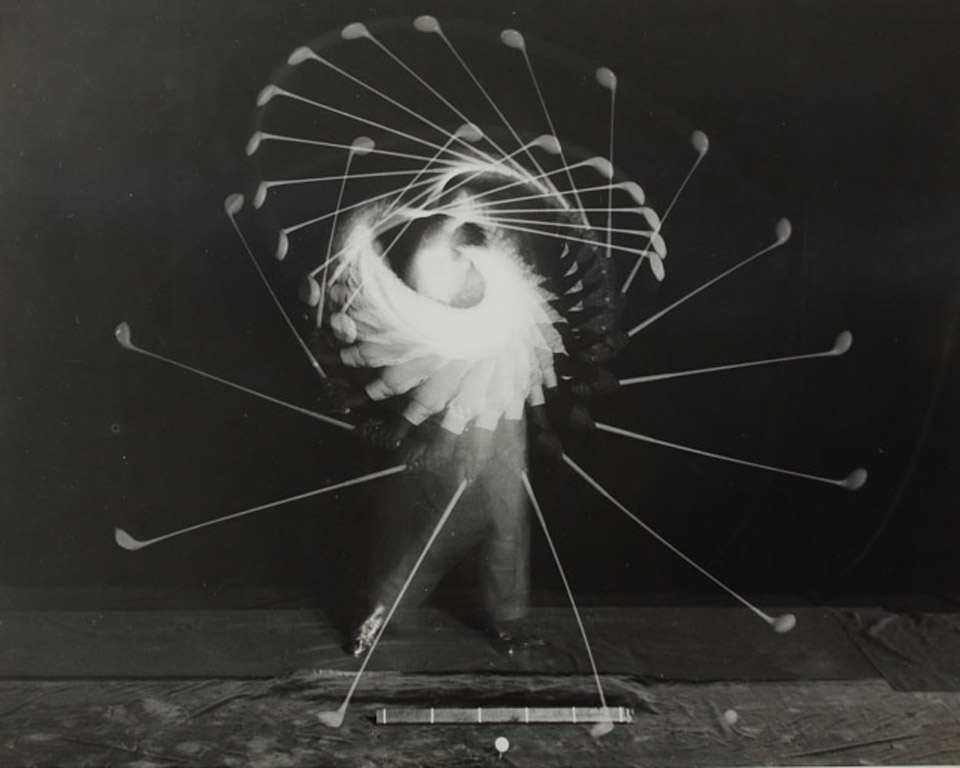
Series of 16 photographs by Harold Edgerton from Bob Jones’s personal collection, 1935
In the twentieth century, photographer Harold Edgerton found a way to scientifically break the game of golf down into its component parts. Inspired perhaps by the science of motion studies and able to exploit new technologies such as stroboscopic photography, Edgerton explored the science behind golf. He dedicated his career at Massachusetts Institute of Technology to photographing phenomena that are impossible to see with the naked eye or capture with traditional cameras. This collection of photographs (there are 16 on view at the museum) features noted golfer, Robert Tyre “Bobby” Jones, Jr., hitting a golf ball. Edgerton selected Jones for a subject because of the golfer’s nearly perfect swing and used photography to deconstruct it. He illustrated how the smallest nuance can have an exponential effect on the golf ball—a reality that instructors and equipment companies have long embraced. This selection of vintage prints was donated to the USGA by the estate of Bobby Jones.Harold Edgerton (American, 1903–1990), Series of 16 photographs by Harold Edgerton from Bob Jones’s personal collection, 1935, printed later. Gelatin silver prints. United States Golf Association Museum, Far Hills, New Jersey, courtesy USGA Museum, Personal Papers of Robert T. Jones, Jr.
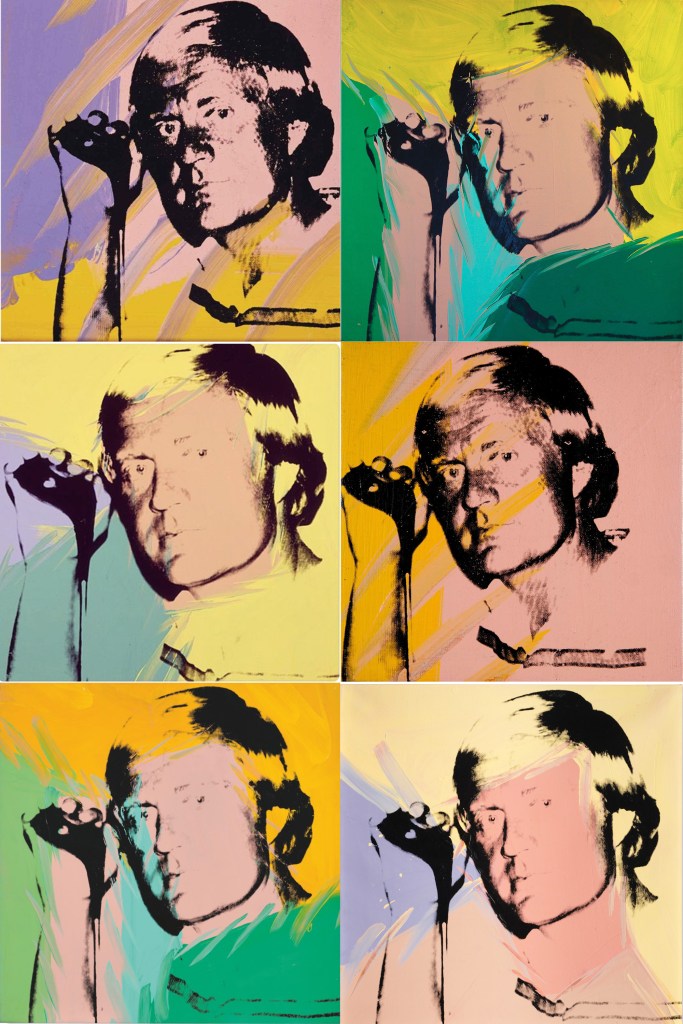
Pop Art master Andy Warhol: “Athletes:Jack Nicklaus”, 1978.
Athletes is a series of silkscreen portraits created by American artist Andy Warhol in 1977. The series was commissioned by Richard Weissman and consists of ten color portraits of the most famous athletes of the time: Muhammad Ali, Kareem Abdul-Jabbar, Chris Evert, Rod Gilbert, O.J. Simpson, Pele, Tom Seaver, Willie Shoemaker, Dorothy Hamill, and Jack Nicklaus.
In 1977, art collector Richard Weisman proposed and idea to his friend Andy Warhol. As an avid sports fan, Weisman suggested that Warhol create a series of screen prints portraying the leading sports stars of the day. Warhol, the leading artist of the pop art movement, was an enthusiast of pop culture and Weisman recognized the growing commercialization of sports. Weisman viewed this project as a way of blending sports and art. In 2007, Wesiman told The Art Newspaper: “I spoke to Andy about the idea; I knew he was a groupie and loved to meet famous people.” According to Weisman’s 2003 book Picasso to Pop: The Richard Weisman Collection, Warhol said, “The sports stars of today are the movie stars of yesterday.”
Ten 40 x 40 inch portraits were commissioned by Weisman for $800,000, and Warhol produced eight sets. One portrait was given to each subject, and one portrait of each subject went to Warhol. Of the other sets, three were given to Weisman’s children, two were given to the University of Maryland Art Gallery and to University of California, Los Angeles, and one was split among the associations pertaining to each sport.
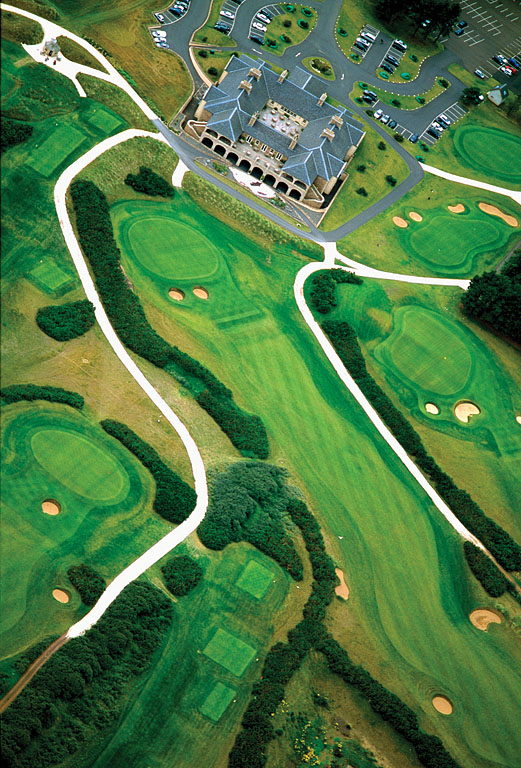
Archerfield Links, East Lothian: the 18th, Dirleton Links Course and Clubhouse, 2011
Patricia and Angus Macdonald work in a unique academic and artistic partnership, based in Scotland, researching, documenting, and interpreting the wide spectrum of cultural landscapes – land affected by human activities – mainly by means of aerial photography and accompanying texts.This group of aerial photographs of famous Scottish golf courses was commissioned specially for this exhibition. The six-part artwork, Bunkered Terrain: Golf Landscapes, Scotland, 2011, is part of an ongoing series titled The Play Grounds, which explores the landscapes of leisure activity both historical and present-day, in both rural and urban contexts.Bunkered Terrain portrays six golf courses representing two contrasting strands of golf-course design. Three are traditional Scottish links courses built around the natural features of the land; such courses are generally considered to achieve considerable harmony with the surrounding environment both visually and ecologically. The other three images feature courses that intrude more on the landscape, transforming the land by means of intensely applied fertilizer and irrigation and large, artificially shaped bunkers and white paths, to produce what the Macdonalds describe as “hyper-real landscapes reminiscent of those of virtual reality.”Patricia Macdonald (Scottish, born 1945) in collaboration with Angus Macdonald (Scottish, born 1945), Archerfield Links, East Lothian: the 18th, Dirleton Links Course and Clubhouse, from Bunkered Terrain: Golf Landscapes, Scotland, 2011M (six-part series), part of the ongoing series The Play Grounds, 2011. Photograph, National Galleries of Scotland, Edinburgh, PGP 809.6.
St Andrews, “Old Course,” 2011
Patricia and Angus Macdonald work in a unique academic and artistic partnership, based in Scotland, researching, documenting, and interpreting the wide spectrum of cultural landscapes – land affected by human activities – mainly by means of aerial photography and accompanying texts.This group of aerial photographs of famous Scottish golf courses was commissioned specially for this exhibition. The six-part artwork, Bunkered Terrain: Golf Landscapes, Scotland, 2011, is part of an ongoing series titled The Play Grounds, which explores the landscapes of leisure activity both historical and present-day, in both rural and urban contexts.Bunkered Terrain portrays six golf courses representing two contrasting strands of golf-course design. Three are traditional Scottish links courses built around the natural features of the land; such courses are generally considered to achieve considerable harmony with the surrounding environment both visually and ecologically. The other three images feature courses that intrude more on the landscape, transforming the land by means of intensely applied fertilizer and irrigation and large, artificially shaped bunkers and white paths, to produce what the Macdonalds describe as “hyper-real landscapes reminiscent of those of virtual reality.”Patricia Macdonald (Scottish, born 1945) in collaboration with Angus Macdonald (Scottish, born 1945), St Andrews, “Old Course,” from Bunkered Terrain: Golf Landscapes, Scotland, 2011 (six-part series), part of the ongoing series The Play Grounds, 2011. Photograph, National Galleries of Scotland, Edinburgh, PGP 809.1.
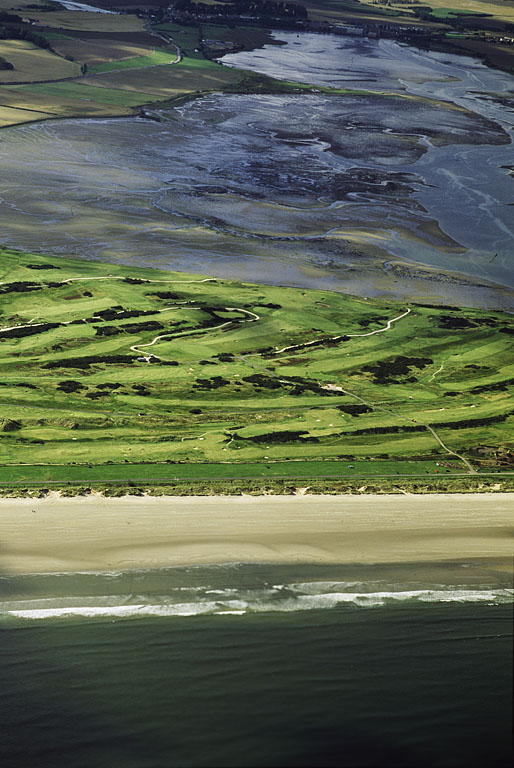
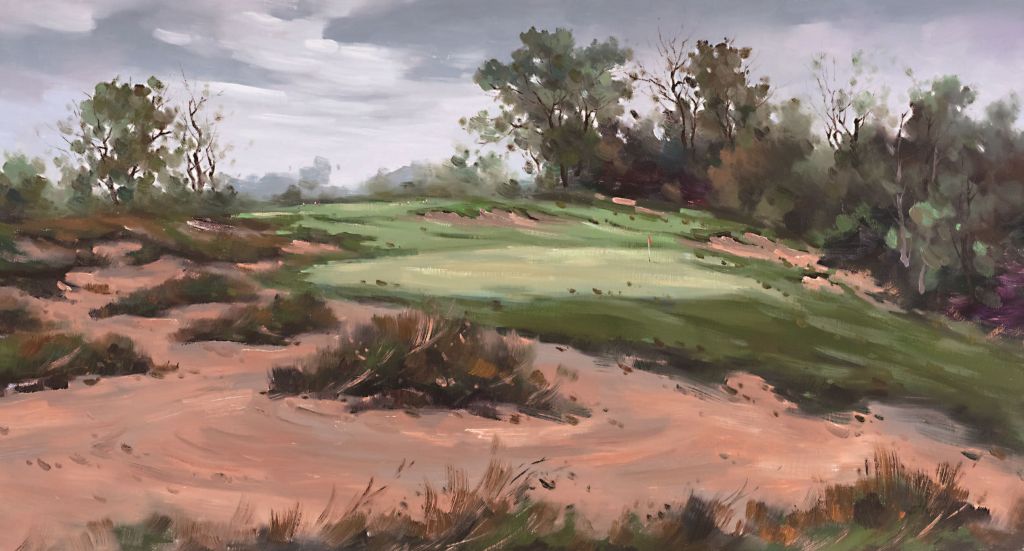
Hudson Shaoxia Zhang’s “Golf Course Landscapes” exhibited at the Florence Bellini Museum, 2024
Artist Hudson Shaoxia Zhang has been a golf fan for over three decades, alongside his influential role as a professor of art history, and over the last six years has dedicated himself to capturing the landscapes of golf courses worldwide through drawing and painting, blending his twin passions of golf and art to create a distinctive and unparalleled body of work.
Through Zhang’s unique perspectives and techniques, visitors are transported to renowned golf courses worldwide, from China’s stunning Jade Dragon Snow Mountain Golf Club to California’s iconic Cypress Point Club, New Jersey’s exclusive Pine Valley Golf Club and the humbler surroundings the Forest of Arden in Warwickshire.
As a professor of art history, Zhang’s plein air scenes evoke historical landscape paintings akin to the works of Jean-Baptiste Corot and David Hockney, who revisited similar subjects. Ultimately, Zhang’s golf course landscapes are dreamscapes – vibrant, diverse, and painted with unwavering passion.
Part of this article is excerpted from “The Art of Golf“and has been supplemented and adjusted.
Organized by the High Museum of Art and the National Galleries of Scotland, The Art of Golf explores how European and American artists have depicted the royal and ancient game for more than four centuries.
 USAGAF